
How Understanding the Four Personality Types, Including Your Own, Changes Everything About How You Lead and Relate By Johanne Edwards, DNM, PhD
Take the survey
A short set of questions about the words that describe you. No right answers, no wrong ones. It takes about two minutes.
Here's how it works
You'll see four words at a time. They're four different ways of describing yourself, and your job is simply to put them in order — from the one that sounds most like you down to the one that sounds least like you. You do that by tapping them in that order.
- 1Your first tap is the word that is most like you. It's worth 4 points.
- 2Your second tap is the next most like you, worth 3 points.
- 3Your third tap is worth 2 points.
- 4The one word left over is the one least like you. It gets 1 point, and fills in on its own.
For example, someone might order a round like this
- 4Most like me Patient
- 3Then Sincere
- 2Then Curious
- 1Least like me Forceful
Before you start, pick one setting and stay in it — how you are at work, or at home, or with friends. Answer as the person you actually are, not the one you're aiming to be.
Tap a word to choose it.
So far this round
Your results
Since the time of the ancient Greeks, observers of human nature have noticed that people fall into recognizable patterns of behavior. Hippocrates, writing more than two thousand years ago, identified four distinct personality types, each with its own characteristic strengths, its own recurring vulnerabilities, and its own essential contribution to the broader human community. He believed that understanding these types was foundational to understanding people, and therefore foundational to medicine, leadership, and any endeavor that required working effectively with human beings.
He was right. And twenty-five centuries later, the insight has not been superseded, only refined, renamed, and validated through an enormous body of psychological research.
The names have changed across cultures and instruments: Hippocrates called them Choleric, Sanguine, Phlegmatic, and Melancholic. Carl Jung organized them differently. Myers and Briggs built a comprehensive instrument from Jungian theory. William Moulton Marston, psychologist, attorney, and the creator of Wonder Woman, developed the framework that became DISC. The categories differ in detail. The underlying observation is strikingly consistent: human beings tend to inhabit one of four primary behavioral orientations, and understanding which one you inhabit, and which ones the people around you inhabit, is one of the most practically powerful things a leader or communicator can do.
The journey inward, understanding your own behavioral style and those of others, is the next frontier of human development. In knowing yourself, you begin to truly know others.

Why Style Awareness Matters More Than You Might Expect
Behavioral styles begin forming early in childhood. By the teenage years they are well established, so established, in fact, that adolescents naturally cluster into groups of similarly wired individuals. The D’s find each other. The I’s find each other. And within those groups, a particular belief solidifies: my way of being in the world is the normal one. The quiet, detail-oriented teenager wonders why the loud, spontaneous one can’t settle down and focus. The outgoing, big-picture thinker wonders why the methodical one has to analyze everything to death before making a move.
Neither style is wrong. Neither is superior. Each has genuine strengths, each has predictable blind spots, and crucially, each is necessary. The organizations and communities that function best are not those populated entirely by one type. They are those in which the four types are present and working together, each contributing what only that style does naturally.
The problem is that most people go through their entire professional lives without this knowledge, relating exclusively from their own style, genuinely baffled by the people who operate differently, and attributing the friction to personality conflicts, bad attitudes, or simple incompetence. When in many cases, the friction is simply two different styles meeting without the awareness needed to bridge them.
The leadership opportunity: A leader who understands behavioral styles can do three things that most leaders cannot: communicate more effectively with each person on their terms, place people in roles that draw on their natural strengths, and build teams where different styles complement rather than collide. That is a significant competitive advantage, built not from strategy, but from self-knowledge.
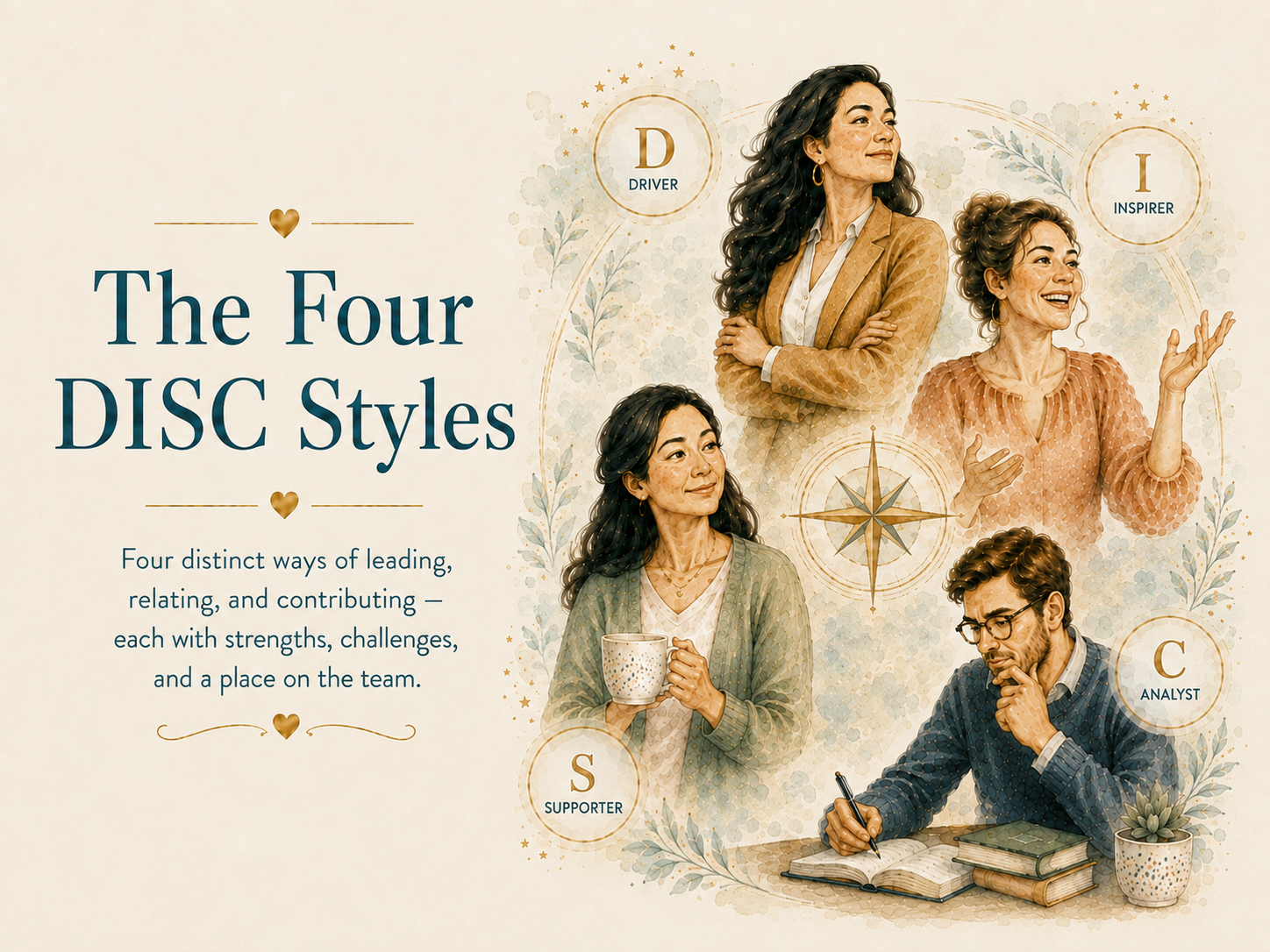
The Four DISC Styles
The DISC model, developed from the work of William Moulton Marston and refined through decades of organizational research, defines four primary behavioral styles. Most people have a dominant style, a secondary style, and use the others to varying degrees depending on context. Here is each style in full:
D – Dominance: The Driver
Strengths: Decisive, results-oriented, direct, confident, natural leader in high-pressure situations. Thrives on challenge. Gets things done.
Challenges: Can become controlling and domineering when under stress. Focuses on the goal at the expense of the people. Prone to workaholism and to taking on more than is sustainable.
Biggest fear: Loss of control. Being taken advantage of. Not achieving the goal.
I – Influence: The Inspirer
Strengths: Enthusiastic, persuasive, optimistic, naturally builds rapport and inspires others. Thrives in social environments. Creative, energetic, great at motivating teams.
Challenges: Can be disorganized and over-committed. Struggles to say no. May prioritize being liked over being effective. Attention to detail and follow-through can suffer.
Biggest fear: Rejection. Social disapproval. Not being liked.
S – Steadiness: The Supporter
Strengths: Loyal, patient, consistent, excellent team builder. Creates harmony and stability. Deeply reliable: the person who is always there when needed. Tenacious and genuinely committed.
Challenges: Resistant to change and conflict. Can become stubborn or passive when pushed. Avoids confrontation even when directness would serve better. Slow to adapt when circumstances demand it.
Biggest fear: Change, conflict, and loss of security or stability.
C Conscientiousness: The Analyst
Strengths: Detail-oriented, precise, analytical, committed to quality and accuracy. Excellent at systems, processes, and ensuring that nothing important is overlooked.
Challenges: Can become paralyzed by overanalysis. Perfectionism can prevent timely decision-making. May struggle with ambiguity and with delegating to people who do not meet their standards.
Biggest fear: Making a mistake. Being wrong. Being criticized for poor quality work.
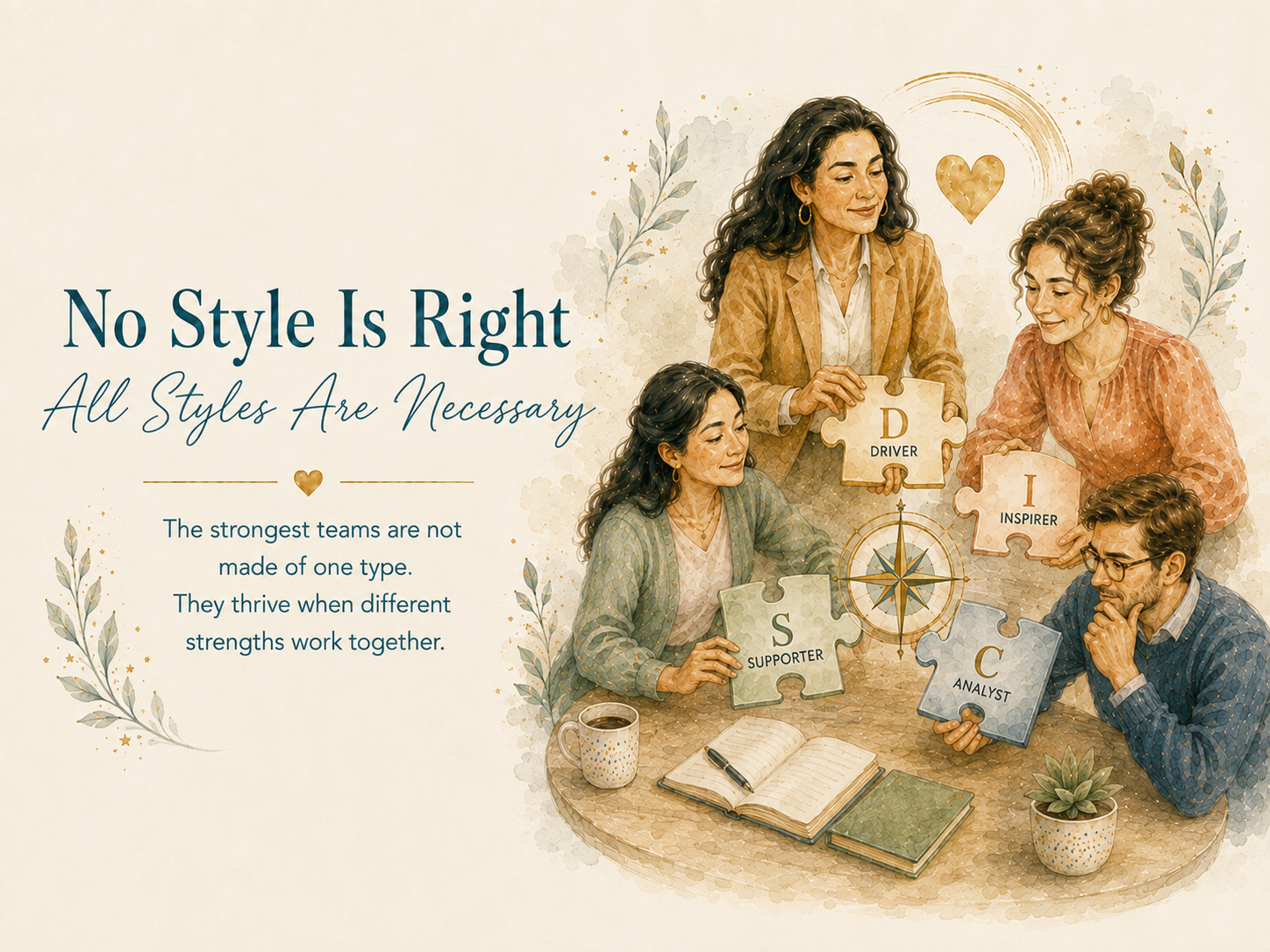
No Style Is Right: All Styles Are Necessary
One of the most important things to understand about behavioral styles is that there is no hierarchy. The D is not a better leader than the S. The I is not more valuable than the C. Each style has qualities the others need, and each has blind spots the others can compensate for.
A team of all D’s will move fast, make bold decisions, and leave a trail of damaged relationships and overlooked details in their wake. A team of all C’s will produce work of extraordinary quality, and still be analyzing the options long after the window of opportunity has closed. A team of all I’s will be energetic, creative, and genuinely enjoyable to work with, and chronically disorganized. A team of all S’s will be harmonious, loyal, and deeply committed, and avoid every necessary conflict until it erupts.
The well-functioning team, like the well-functioning community, needs all four. The leader’s job is not to recruit people who all think the same way. It is to understand the styles present on the team, appreciate what each one contributes, manage the predictable friction between styles with awareness rather than frustration, and place people in roles where their natural strengths are at the center of what they are being asked to do.
There is no right style. There is only your style (with its particular strengths and its predictable challenges), and the styles of the people around you, which are equally valid and equally necessary.
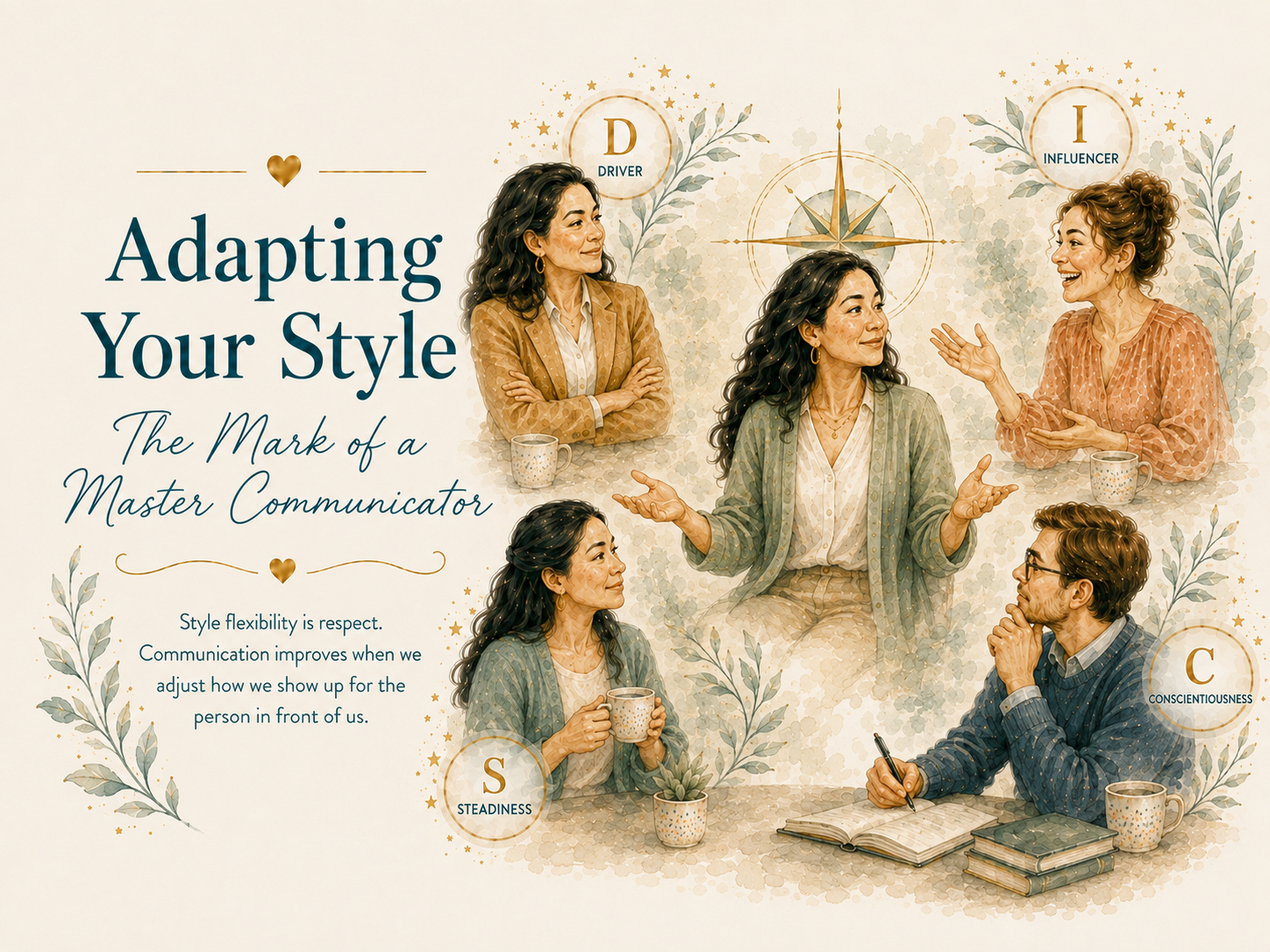
Adapting Your Style: The Mark of a Master Communicator
Each of us tends to operate primarily from our dominant style. And within that style, we have a natural way of communicating, deciding, influencing, and relating. The problem is that not everyone around us shares our style, which means that what feels natural and clear to us may feel abrasive, scattered, slow, or imprecise to someone wired differently.
Style awareness without style flexibility is only half the skill. The full skill is the ability to recognize the style of the person you are working with and adapt your approach accordingly, not by abandoning who you are, but by adjusting how you show up.
With a high D: be direct, be brief, be results-focused. Do not waste their time with excessive process or preamble. Give them the bottom line and the options.
With a high I: be warm, be enthusiastic, allow time for connection before diving into business. Acknowledge them personally. Make the conversation engaging, not just efficient.
With a high S: be patient, be reassuring, avoid sudden changes without explanation. Give them time to adjust. Value their loyalty and their consistent contribution explicitly.
With a high C: be precise, be prepared, come with data and evidence. Respect their need for accuracy and detail. Do not pressure them for a quick decision on something they have not had time to properly analyze.
In practice: Style flexibility is not manipulation; it is respect. It is the recognition that effective communication is not about how clearly you send the message, but about how well it lands in the particular person you are speaking with. Adjusting your style to theirs is the most practical form of respect available to a leader.

Knowing Yourself to Know Others
The ancient Oracle at Delphi offered two words of counsel above all others: Know thyself. Twenty-five centuries later, every major framework in leadership development, organizational psychology, and interpersonal effectiveness points to the same starting place.
You cannot lead what you do not understand. You cannot bridge a gap you cannot see. You cannot leverage the strengths of a team you have not taken the time to map. And none of that understanding of others, your team, or the dynamics in the room is fully available to you until you have done the foundational work of understanding yourself.
Discovering your own behavioral style is not an endpoint. It is the beginning of a journey, inward first, and then outward, toward a richer, more effective, more genuinely human way of working with the extraordinary variety of people who surround you.
- Identify your dominant behavior style. Consider taking my full validated assessment (Carlson Learning’s DISC) to understand your profile with precision. Self-identification is a useful starting point; professional assessment gives you much more.
- Name your strengths and your blind spots. Your style’s strengths are not the whole picture. The predictable challenges are equally important to understand, because they tend to show up most reliably under stress and in high-stakes situations.
- Map the styles of your team. Once you understand your own profile, begin noticing the styles of the people you work with most closely. Where are the natural tensions? Where are the natural complements?
- Practice style flexibility. In your next significant conversation, notice the other person’s likely style, and consciously adjust your approach. Lead with what they need to hear, in the way they need to hear it.
- Build a style-diverse team deliberately. Audit your current team. If everyone on it thinks the way you do, that is a risk, not an asset. Seek out the styles that are missing, and value them when you find them.
Knowledge, as the original article says, is power. And at the core of that power, more foundational than any strategy, any tool, or any technique, is knowledge of yourself and of the people you are privileged to lead.
What style are you? And what will you do with that knowledge?