
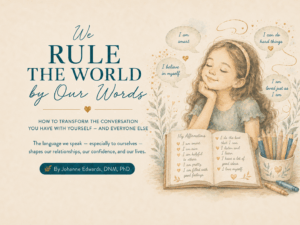
How to Transform the Conversation You Have With Yourself, and Everyone Else
By Johanne Edwards, DNM, PhD
Napoleon Bonaparte observed that we rule the world by our words. Few insights from that era have aged better. The words we choose, the ones we speak aloud and, perhaps more powerfully, the ones we repeat silently to ourselves, shape our self-image, our relationships, our leadership, and ultimately our lives.
Consider for a moment the language you use on an average day. Do your words tend toward criticism or praise? Does your conversation lean negative or positive? Are you reaching, in most exchanges, to be right, or to be genuinely kind and curious? These are not small questions. The answers reveal the architecture of your inner world, and they go a long way toward explaining the quality of your outer one.
A striking fact: Research suggests that human beings spend approximately 95 percent of their communicative energy in internal conversation, talking to themselves, and only about 5 percent in genuine outward listening. We are, by design, primarily talking to ourselves. The question is: what are we saying?
No wonder authentic communication is so difficult. Most of us arrive at any conversation already mid-monologue. Before the other person has finished their first sentence, we are composing our response, rehearsing our position, filtering what we hear through the ongoing commentary of our own inner voice. True listening, the kind that makes another person feel genuinely received, requires something most of us have never been taught: the ability to quiet that internal chatter long enough to actually hear.
“We rule the world by our words.”
Napoleon Bonaparte

The Radio That Plays All Day
My daughter Natalie, at nine years old, was struggling. Not with anything visible, she was bright, warm, and capable. But inside, a radio was playing, and it played the same stations on repeat: I’m not pretty. Nobody likes me. I have no friends. I’m not smart. Other kids have it better than me.
The words were creating a great deal of sadness in her young life. Not because they were true, they were not, but because she was hearing them constantly, believing them quietly, and they were shaping how she moved through every day.
So we sat down together and wrote them out. Every negative statement that played on her inner radio, we wrote down. Then, beside each one, we wrote the opposite. We called it Natalie’s Little Chatter Box. She agreed to read it every morning when she woke up and every evening before bed. As she got older, she recorded the affirmations on cassette and listened to them. The impact on her self-concept was genuine and lasting, she carried those statements with her into her teenage years and beyond.
She has given me permission to share them here. Not as a script, but as an example of what it looks like when a young person (or anyone) deliberately rewrites the language of their inner world.
Natalie’s Little Chatter Box
Positive affirmations for when the inner voice needs a new tune
- I am smart.
- I am nice.
- I am helpful to others.
- I am pretty.
- I am filled with good feelings.
- I do the best that I can.
- I listen and I learn.
- I have a great family, including Charlie.
- I have a lot of good ideas.
- I love myself.
- I don’t care about what other people say, just about what I know to be true.
- Everything I need to know is inside of me.
- Whatever happens in life, I can handle it.
- I am sensitive.
- I have so much to give.
- I am a responsible human being.
- I am loving and caring for others.
- I choose to be happy.
- My self-esteem is growing every day.
What strikes me most about Natalie’s list, reading it now, years later, is how simple and how powerful these statements are. None of them are grandiose. They do not claim perfection or guarantee outcomes. They are simply honest, kind, and true. They are the things a loving parent, teacher, or friend might say. Natalie learned to say them to herself.
We all can.
Intrapersonal Before Interpersonal
There is a direct line between the quality of the conversation we have with ourselves, what communication scholars call intrapersonal communication, and the quality of every conversation we have with others. You cannot consistently speak with generosity and clarity to the people around you if you are drowning in self-criticism and negative self-talk on the inside.
The inner voice sets the tone for everything that follows. If it is habitually harsh, fearful, or dismissive, those qualities will leak into our outward communication in ways we may not even notice, a sharpness of tone, a quickness to judge, a difficulty receiving what others are genuinely trying to offer us.
Improving our intrapersonal dialogue, deliberately choosing kinder, more honest, more constructive language for the conversation we have with ourselves, is therefore not a personal indulgence. It is the foundation of better communication with everyone else. The work begins inside.
From neuroscience: The brain processes self-directed language in ways remarkably similar to how it processes language spoken by others. Repeated negative self-talk activates the same stress responses as external criticism, which means the inner voice is not neutral background noise. It is shaping our physiology, our mood, and our behavior every day.
“There are no uninteresting people, only disinterested listeners.”
Bob Conklin

The Rarest Gift: Genuine Listening
Bob Conklin, the motivational author and speaker, made an observation that has stayed with me for years: there are no uninteresting people, only disinterested listeners. It is a gentle but pointed challenge. The assumption that some people are simply boring, that some conversations are inherently not worth our full attention, says less about the speaker than it does about the quality of attention we are bringing.
True listening is rare. Most of us listen at people, we absorb enough to formulate our reply, catch the main points, wait for our turn. Genuine listening is something different. It is the act of setting aside our own internal commentary long enough to actually receive what another person is offering. It requires presence. It requires the willingness to be changed, even slightly, by what we hear.
And it is, as I often say in my work, one of the greatest gifts we can give another human being. To be truly heard, to speak to someone and feel, with certainty, that your words actually landed, is an experience so rare that most people can count on one hand the people in their lives who offer it consistently.
You can be one of those people. It begins with a decision to show up fully, to turn down the volume on your own inner chatterbox long enough to make genuine room for someone else.
The Four A’s of Expansive Listening
One of the most practical frameworks I have used in leadership development and communication seminars is what I call the Four A’s of Listening. These are not techniques for appearing engaged, they are practices for being engaged, and they change the quality of communication in every context where they are applied.
1. Acknowledge, Make it clear that you have heard what was said. This does not require agreement, simply recognition. Repeat back the key point, offer a brief summary, or give a nod that signals: I received that. You were heard.
2. Ask, Invite more. “Tell me more about that.” “What do you mean when you say…?” “Can you help me understand…?” Genuine curiosity, the kind that asks because it actually wants to know, is among the most powerful forces in human communication. It tells the other person that their perspective matters enough to explore.
3. Align, Find what you can genuinely agree with. You do not need to endorse the whole of what someone has said to acknowledge the parts that resonate. Alignment, even partial alignment, breaks down defensiveness and creates the conditions in which real dialogue becomes possible.
4. Add, Once you have acknowledged, asked, and aligned, you have earned the space to contribute your own perspective. Adding comes last, not because your view is less important, but because a perspective offered into a conversation where the other person feels heard lands very differently than one offered into a debate where no one is listening.
These four steps transform the experience of being in conversation with you. They shift the dynamic from an exchange of competing monologues to something that genuinely qualifies as dialogue, two people actually thinking together, rather than simply waiting for each other to stop talking.
The Words We Add to Other People’s Chatterboxes
Here is something worth sitting with: every significant conversation you have either adds something constructive to the inner chatterbox of the person you are speaking with, or it does not.
The words we offer to others do not simply pass through the air and disappear. They land. They are absorbed. The careless criticism, the dismissive aside, the sarcastic comment that felt clever in the moment, these become part of the ongoing inner conversation of the person who received them. Sometimes for years.
We have all carried sentences that someone said to us long ago. A parent’s offhand remark that became a belief about our intelligence. A teacher’s impatient comment that became a story about our capability. A partner’s frustrated accusation that became a narrative about our worth. We did not choose to carry these things. They simply stuck.
This means that the question of what kind of communicator we are is not only about our own self-expression. It is about our impact. It is about what we are choosing to add, or not add, to the inner lives of the people we encounter.
Be kind enough not to add negative sentences to the vocabulary of another’s mental chatterbox. The words we give others become part of how they hear themselves.
We can choose to be people who leave others slightly more capable, more seen, and more encouraged than before they spoke with us. That is not a small thing. That is, in fact, one of the most significant things any of us can do.
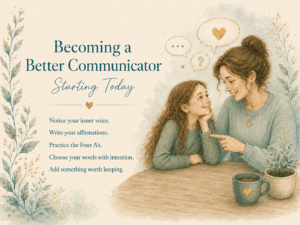
Becoming a Better Communicator, Starting Today
Communication is a skill. Like all skills it improves with deliberate, honest practice. Here is where to begin:
- Listen to your inner voice this week. Not to judge it, simply to notice it. What is the tone? What does it say about you, about others, about what is possible? You cannot rewrite the chatterbox until you know what it is currently saying.
- Write your own affirmation list. Not Natalie’s, yours. What do you most need to hear? What would a genuinely loving, honest inner voice say to you? Write it down. Read it. Then read it again tomorrow.
- Practice the Four A’s in one conversation today. Choose one exchange, with a colleague, a family member, a friend, and move through all four steps before offering your own view. Notice what changes.
- Choose your words with intention. Before you speak, especially in a charged moment, ask: Is this true? Is this kind? Is this necessary? You do not have to say everything you think. What you do say carries weight.
- Be conscious of what you are adding to others’ chatterboxes. In every significant conversation, you are either contributing to someone’s sense of possibility or quietly diminishing it. Choose, as deliberately as you can, to add something worth keeping.
Napoleon was right: we rule the world by our words. We rule our own inner world first. And from there, conversation by conversation, word by word, one genuinely heard exchange at a time, we shape the world we share with everyone else.