

Why Encouragement Is the Most Powerful Force in Learning, and How Every One of Us Can Offer It
By Johanne Edwards, DNM, PhD
I started school with a hunger for knowledge. Books fascinated me. I could not wait to sit beside classmates, share ideas, and lose myself in the great adventure of learning. That desire was as natural and as uncomplicated as breathing.
In the third grade, my parents enrolled me in a parochial school. What happened there changed the course of my life… not immediately for the better.
The teachers at that school used physical punishment as a tool of discipline and instruction. What had been joy became dread. What had been curiosity became caution. My self-esteem quietly eroded, and with it, my capacity to learn. By the time I left, I could barely advance from one grade to the next.
By eighth grade, I had been transferred back into the public school system and placed in the slow-learner group, a classroom populated largely by students with severe behavioral challenges. I sat there, quiet and diminished, certain that this was simply where I belonged.
It was not until I was well into my sixties that I discovered something that reframed my entire early story: I have ADHD and dyslexia. I had carried those conditions my whole life without a name for them, without any framework to understand why learning had felt so impossibly hard, or why the punishment I received had compounded the struggle so cruelly. Those teachers had not been disciplining a defiant child. They had been punishing a brain that was simply wired differently.
That discovery did not arrive with bitterness. It arrived with something closer to compassion, for the little girl who had been made to feel broken, and for the adults around her who simply did not know what they did not know.
A note on neurodiversity: ADHD and dyslexia are among the most commonly undiagnosed conditions in adults, particularly in women of earlier generations, when diagnostic awareness was far more limited and the presentation in girls was frequently missed. Many high-achieving adults carry these conditions without ever receiving a name for what they experienced. A late diagnosis does not diminish the achievement. It illuminates the resilience.
— + —
The Six Words That Changed Everything
Then something happened that altered the entire direction of my life.
My eighth-grade math teacher looked at me one day, really looked, and said quietly: “You don’t belong here. You can be better than this.”
I do not know exactly what shifted inside me in that moment. I could not have named it then. But something changed, irrevocably, permanently, and all at once. Not because of any technique or program. Because one person chose to see me differently than the circumstances suggested I should be seen.
See people as they are, and they will stay there. See people as they could be, and you will help them grow.
By the end of that semester I had straight A’s and a place on the dean’s list. By the end of that year I was in advanced classes and the college preparatory curriculum. I placed in the top twenty at the science fair. I joined the choir, discovered a talent for music, and was selected for a special ensemble group.
From there I went on to become an engineer, a consultant, and a human potential trainer. I have never stopped loving to learn.
All of it traces back to a single act of genuine encouragement, six words spoken by someone who chose to look past my circumstances and see my potential. The content of those words mattered far less than what they carried: faith. The faith of another person, expressed through their eyes and their voice, that they could already see me succeeding before I could see it myself.
— + —
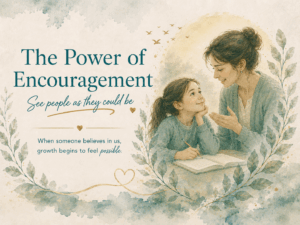
The Power Every “Encourager” Carries
This is not a story about one exceptional teacher. It is a story about what every one of us is capable of offering, and how rarely we do.
Encouragement is not flattery. It is not the empty praise that tells a child every drawing is a masterpiece or every answer is correct. Genuine encouragement is something far more specific and far more powerful: it is the act of seeing someone’s real potential and reflecting it back to them with enough conviction that they begin, perhaps for the first time, to see it too.
We tend to assume that this is the responsibility of teachers, parents, coaches, or managers, people with formal roles in others’ development. But the truth is more democratic than that. Every single one of us, in the ordinary course of a day, moves through conversations where we have the choice to either confirm someone’s smallest belief about themselves or quietly, firmly contradict it.
A colleague who is struggling with a new skill. A child who has decided she is not good at math. A team member who has stopped offering ideas because they were once dismissed. An adult learner who walked into a classroom for the first time in twenty years and sat in the back row, certain they did not belong there.
Every one of them is waiting, whether they know it or not, for someone to look at them the way my teacher looked at me.
From educational research: The landmark Rosenthal and Jacobson “Pygmalion in the Classroom” study demonstrated that teacher expectations measurably affect student performance — independent of actual ability. Students whose teachers expected them to grow, grew. The belief came first. The achievement followed. What we genuinely expect of people tends to become what we get from them.
“The faith someone demonstrates through their eyes, their genuine belief that they can already see you succeeding, is among the most transformative gifts one human being can offer another.”
— + —
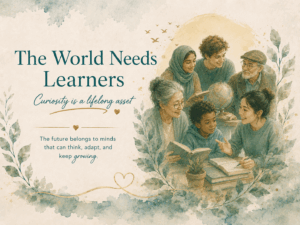
The World That Needs This More Than Ever
We are living through a moment of profound economic and educational transformation. The economist Robert Reich, in his landmark work The Work of Nations, framed the stakes clearly:
“In the coming century there will be no national products or technologies, no national corporations, no national industries. There will no longer be national economies. All that will remain rooted within national borders are the people who comprise a nation. Each nation’s primary assets will be its citizens’ skills.”
— Robert Reich, The Work of Nations
We are now living inside that forecast. The global economy does not reward the accumulation of fixed knowledge, it rewards the ability to think, adapt, create, and collaborate. What we know today may be substantially revised within two to four years. What will never be obsolete is the capacity to learn, and that capacity is inseparable from the belief that learning is something you are capable of.
The education system of the Industrial Age was designed to prepare people for repetitive, structured work, to follow instructions and perform reliably within known systems. That model served its era. It does not serve ours. The Knowledge Age demands something fundamentally different:
-
Conceptual and critical thinking — generating original solutions rather than applying known ones
-
Comfort with risk and experimentation — the willingness to try, fail, learn, and try again
-
Adaptability — treating disruption as invitation rather than threat
-
Collaboration — thinking and creating alongside others, across disciplines and difference
-
Emotional intelligence — understanding yourself and others well enough to lead and contribute effectively
-
Lifelong curiosity — learning not for a credential, but because growth is genuinely worthwhile
None of these skills grow in an environment of fear or diminishment. All of them require a learner who believes, at some fundamental level, that they are capable of more than they have yet demonstrated. Which means that every environment where learning happens is also an environment where encouragement either flourishes or withers. And the people who shape that environment are not only professional educators. They are all of us.
— + —
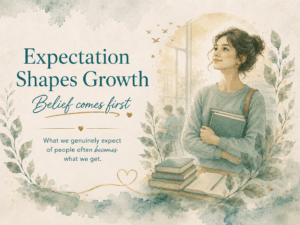
We All Carry Someone’s Potential in Our Hands
Think about the person in your own story, the one whose words, or whose eyes, changed something for you. Most people have one. A parent, a teacher, a coach, a friend, a colleague who looked at you at a critical moment and saw something you had not yet seen in yourself.
Now consider the inverse: how many people in your daily life are waiting for exactly that? Not for a program, not for a credential, not for the right circumstances, but for one person to look at them with genuine conviction and say, in whatever words fit the moment: You don’t belong in the small version of yourself. You are capable of more than this.
That is not a large ask. It does not require a formal role or a particular expertise. It requires only the willingness to pay close enough attention to actually see the person in front of you, and then the courage to say what you see.
See people as they are, and they will tend to stay there. See people as they could be, hold that vision steadily, reflect it back with genuine belief, and you become part of what helps them grow into it.
The “encourager” does not need to be a teacher. They need only to be present, honest, and willing to believe in someone before that person can fully believe in themselves. That is the whole gift. And it is available to every one of us, in every ordinary conversation, on any unremarkable day.
— + —

Rekindling the Passion — Where to Begin
We all began with that hunger. The child who could not wait to open a book, to ask a question, to find out how things worked. For some of us, that hunger was nurtured. For others, like me, it was systematically discouraged. But it was never destroyed. Only buried.
The work of lifelong learning begins with unearthing it. Here is where to start:
-
Identify the story you carry about your own learning. — Was there a moment that lifted yo, or one that diminished you? Understanding the origin of your current relationship with learning is the first step toward changing it.
-
Choose one area of genuine curiosity and follow it. — Not a skill you feel you should develop, something you are actually drawn to. Intrinsic motivation is the fuel of lifelong learning. Obligation depletes it.
-
Embrace being a beginner. — The Knowledge Age rewards those who can tolerate not-knowing long enough to learn. Comfort with incompetence, the inevitable first stage of any new skill, is itself a learnable skill.
-
Be an “encourager”. — Identify one person in your life who is struggling, shrinking, or holding back. Look at them honestly. See what they are capable of, not just what they are currently demonstrating. Then find the words, however simple, to reflect that vision back to them.
-
Make learning a daily practice, not an occasional event. — Read widely. Ask questions you cannot immediately answer. Seek out people whose perspective challenges yours. The mind that is regularly stretched rarely returns to its original dimensions.
The economy is changing faster than at any point in human history. The skill sets of yesterday will not carry us through tomorrow. But the capacity to learn, to stay curious, to remain open, to believe that growth is always still possible, is ageless. And it is the one asset that compounds with use.
Someone once saw more in me than I could see in myself. That vision changed the entire course of my life.
You have that same power. Use it.