

The Difference Between Self-Confidence and Self-Esteem, and Why It Changes Everything
By Johanne Edwards, DNM, PhD
Are you a human being, or a human doing?
Most of us, if we are honest, spend the vast majority of our lives doing. We do the job. We do the marriage. We do the kids, the errands, the obligations, the to-do lists that never quite end. We keep doing and doing, often at a pace that leaves no room to simply exist — to rest, to breathe, to feel, to just be.
Some people wear this busyness as a badge of honor. Extreme doers become workaholics. Others overschedule, double-book, and layer commitment upon commitment until they have no idea what rest even feels like. Some are so attached to their list of things to do that they genuinely worry about who will take care of it all when they are gone.
But here is the question worth sitting with: in all that doing, who are you being?
Self-confidence comes from doing. Self-esteem comes from being, from holding yourself in high enough regard to accept who you are, exactly as you are.
— + —
The Difference Between Self-Confidence and Self-Esteem
These two concepts are often used interchangeably, but they are not the same, and understanding the difference may be one of the most important things you ever do for yourself.
Self-confidence grows when we do and accomplish things. When we set goals and achieve them, when we finish projects and master skills, we build what might be called our self-confidence muscle. Accomplishment feels good, and it should. There is real value in knowing what you are capable of.
Self-esteem is something deeper and more essential. It is not earned through achievement. It grows when we believe that we are worthy, not because of what we have done, but because of who we are. Self-esteem is the quiet, unshakeable sense that you are valuable, lovable, and enough, even when you are not producing anything at all.
The problem is that many high achievers have strong self-confidence and very little genuine self-esteem. They can accomplish almost anything, but they cannot accept themselves without the accomplishment. Remove the doing, and they are left with a troubling emptiness.

The Power of a Thick Face
The philosopher Chu spoke of those who possess what he called a thick face, people who can be criticized without being destabilized by it. Not because they are indifferent to feedback, but because they hold themselves in such high regard that no external judgment can shake their core sense of worth.
These are people who can see the wonder and power in their own reflection, not with arrogance, but with a deep, settled appreciation for who they are. They do not need the approval of others to feel valuable. They already know.
There is real power in loving ourselves unconditionally in this way. When we are rooted in genuine self-worth, we are not easily blown about by the opinions of others. We can receive criticism without collapsing, and praise without becoming dependent on it.
When we are rooted in genuine self-worth, we are not easily blown about by the opinions of others.
— + —
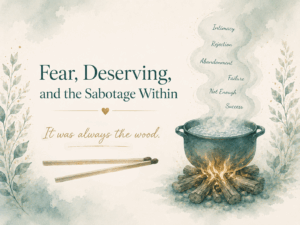
Fear, Deserving, and the Sabotage Within
When we possess high self-esteem and high self-confidence, we naturally feel deserving of good things — of love, of success, of health, of happiness. But when self-esteem is low, something more insidious takes over: fear. And fear is one of the most effective saboteurs in existence.
Whatever we focus on expands. When we focus on our fears, we do not simply feel more afraid, we often bring about the very outcomes we dread. Our attention shapes our perception, our perception shapes our behavior, and our behavior shapes our reality.
Consider someone trying to lose weight who, despite their best efforts, cannot seem to make lasting progress. On the surface, it looks like a willpower problem. But what if the real issue is a fear of intimacy, and the weight is serving an unconscious protective function, keeping people at a safe distance? In that case, no diet in the world will deliver lasting results, because the real problem is not the food. It is the fear underneath the food.
This is the pot of boiling water. We exhaust ourselves trying to manage the steam, or “the symptoms” without ever addressing the fire underneath. The fear is the firewood. When we find it and face it, the water begins to cool on its own.
The problem was never the water. It was always the wood.
— + —

Where Are You Sabotaging Yourself?
It takes honesty and courage to ask these questions, but they are the questions that can set us free. Take a moment to sit with them:
A Moment of Honest Self-Reflection
- How have I chosen to sabotage myself so I don’t have to face my fears?
- Do I overeat, overspend, over-commit, or under-deliver?
- Do I procrastinate, people-please, or withdraw when things get difficult?
- Do I become sad or depressed when I sense that something good might actually happen?
- What am I truly afraid of? Loss of security? Intimacy? Rejection? Abandonment? Success? Failure?
- Do I feel genuinely deserving of the life I say I want?
— + —

Moving Through Fear, Not Around It
The goal is not to eliminate fear. Fear is a natural part of being human. The goal is to stop letting it make decisions on your behalf.
Susan Jeffers, in her landmark book Feel the Fear and Do It Anyway, captured it perfectly: pushing through fear is far less frightening than the paralysis that comes from the feeling of helplessness. When we avoid our fears, they grow. When we face them, they lose their power over us, not all at once, but incrementally, step by step.
Once we identify our fears and understand how they have been quietly running the show, something opens up. We become free, free to ask for what we want, free to pursue what we deserve, and free to actually allow it when it arrives.
“You gain strength, courage, and confidence by every experience in which you really stop to look fear in the face. You must do the thing you think you cannot.” — Eleanor Roosevelt

You Are Enough, Right Now
Here is the truth that too many of us spend a lifetime trying to earn our way to: you are already enough. Not because of what you have accomplished, not because of how much you produce, and not because of how busy you manage to stay. You are enough because you are here, a human being, not merely a human doing.
Balance the being and the doing. Let your accomplishments build your confidence, but let your humanity build your esteem. When you hold yourself in genuine high regard, when you love yourself enough to take care of your health, give yourself permission to rest, and believe that you deserve the things you deeply want, everything changes.
You stop sabotaging what you most desire. You stop feeding the fire under the pot. And you discover that the life you have been working so hard to build has been waiting for you all along, you just had to believe you deserved to live it.